

'An idea whose time has come’ – Senate Advances Kids Online Safety Act Following FACT-Signed Letter
Aug 20, 2026 by FACT

Kids today are growing up in a digital world no generation before them ever had to survive – one engineered by trillion-dollar companies to capture their attention, harvest their data, and, increasingly, offer them counterfeit companionship through AI chatbots built to feel like a friend. Whether we like it or not, this is the world our children are living in. That's why FACT has been on the front lines pushing Congress to enact real protections that help parents navigate the complex, and often predatory, online world.
The single most important piece of that fight is currently moving through Congress. It’s known as the Kids Online Safety Act (KOSA), and was introduced by Tennessee Senator Marsha Blackburn, who argues that "Big Tech platforms have shown time and time again they will always prioritize their bottom line over the safety of our children."
At its core, KOSA would require online platforms likely to be used by minors to enable the strongest privacy settings by default, uphold a legally enforceable "duty of care" to prevent and mitigate specific dangers to kids, give parents and educators new tools to protect children, and submit to independent audits and research into how these platforms affect young users.
KOSA has faced several roadblocks since Blackburn first introduced it four years ago. In July 2024, it eventually passed the full Senate by a resounding 91-3 vote. It later died in the House after leadership refused to bring it to a floor vote. Blackburn and Sen. Richard Blumenthal reintroduced it in May 2025, calling it "an idea whose time has come," with the backing of both party leaders.
On February 11, 2026, Tennessee Attorney General Jonathan Skrmetti led a bipartisan coalition of 40 attorneys general urging Congress to pass KOSA, warning that social media platforms "are intentionally designed to be addictive, particularly for underage users."
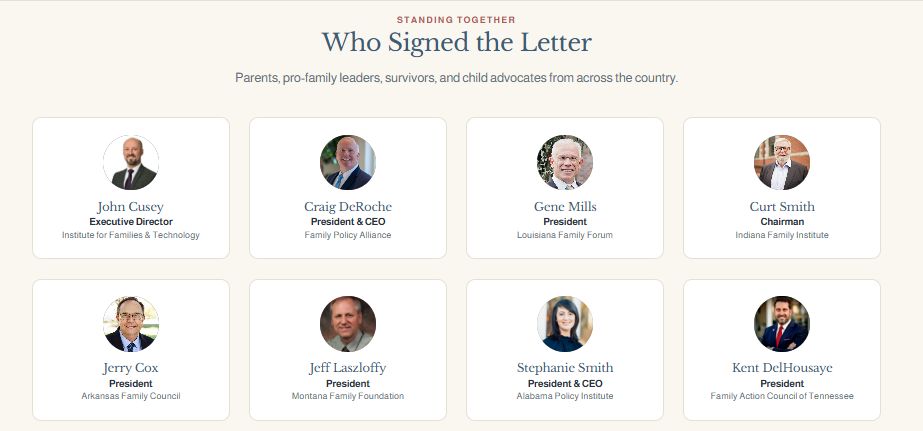
On July 30, FACT joined more than two dozen pro-family organizations – including Family Policy Alliance, Moms for Liberty, the Institute for Family Studies, and the Ethics and Public Policy Center – in sending a letter to Senate Commerce Committee Chairman Ted Cruz and Ranking Member Maria Cantwell, urging them to advance the bill.
The letter asked the committee to hold the line on two principles, which were removed from a similar bill in the House. First, a "duty of care" requirement. The letter argued that just as we require carmakers to install seatbelts and airbags, and just as we restrict marketing alcohol and tobacco to children, Big Tech should be legally required to design its products to avoid foreseeable harm to kids. Second, build on state law rather than preempt it. The letter warned against "any demand to grant preemptive immunity for emerging technology (especially generative AI) in exchange for ratifications of protections on other technologies.”
"The voices who tell you this principle means emerging technology should get free rein with our children do not speak for us!" the letter states. The Institute for Families & Technology has since launched familiesandtech.org as a clearinghouse for the effort, with plans to amplify aligned work across the country.
Six days after the letter was submitted, the Senate Commerce Committee unanimously advanced KOSA with the duty-of-care provision intact. Chairman Cruz called it a bill that "with 75 cosponsors, many of whom are on this committee, and a 91-to-3 Senate vote last Congress... represents a major effort to protect children online."
KOSA now awaits a full Senate floor vote before heading into negotiations with the House, where the fight over duty of care and preemption will be decided. We will continue to update you as the legislation progresses through Congress. Click here to sign up for our weekly newsletter to stay informed!
FACT remains committed to standing with Tennessee parents against a Big Tech industry that profits from children's addiction and attention. Learn more about the coalition's work at familiesandtech.org, and consider supporting our work here.
The single most important piece of that fight is currently moving through Congress. It’s known as the Kids Online Safety Act (KOSA), and was introduced by Tennessee Senator Marsha Blackburn, who argues that "Big Tech platforms have shown time and time again they will always prioritize their bottom line over the safety of our children."
Background
At its core, KOSA would require online platforms likely to be used by minors to enable the strongest privacy settings by default, uphold a legally enforceable "duty of care" to prevent and mitigate specific dangers to kids, give parents and educators new tools to protect children, and submit to independent audits and research into how these platforms affect young users.
KOSA has faced several roadblocks since Blackburn first introduced it four years ago. In July 2024, it eventually passed the full Senate by a resounding 91-3 vote. It later died in the House after leadership refused to bring it to a floor vote. Blackburn and Sen. Richard Blumenthal reintroduced it in May 2025, calling it "an idea whose time has come," with the backing of both party leaders.
On February 11, 2026, Tennessee Attorney General Jonathan Skrmetti led a bipartisan coalition of 40 attorneys general urging Congress to pass KOSA, warning that social media platforms "are intentionally designed to be addictive, particularly for underage users."
On July 30, FACT joined more than two dozen pro-family organizations – including Family Policy Alliance, Moms for Liberty, the Institute for Family Studies, and the Ethics and Public Policy Center – in sending a letter to Senate Commerce Committee Chairman Ted Cruz and Ranking Member Maria Cantwell, urging them to advance the bill.
The letter asked the committee to hold the line on two principles, which were removed from a similar bill in the House. First, a "duty of care" requirement. The letter argued that just as we require carmakers to install seatbelts and airbags, and just as we restrict marketing alcohol and tobacco to children, Big Tech should be legally required to design its products to avoid foreseeable harm to kids. Second, build on state law rather than preempt it. The letter warned against "any demand to grant preemptive immunity for emerging technology (especially generative AI) in exchange for ratifications of protections on other technologies.”
"The voices who tell you this principle means emerging technology should get free rein with our children do not speak for us!" the letter states. The Institute for Families & Technology has since launched familiesandtech.org as a clearinghouse for the effort, with plans to amplify aligned work across the country.
Progress
Six days after the letter was submitted, the Senate Commerce Committee unanimously advanced KOSA with the duty-of-care provision intact. Chairman Cruz called it a bill that "with 75 cosponsors, many of whom are on this committee, and a 91-to-3 Senate vote last Congress... represents a major effort to protect children online."
Next Steps
KOSA now awaits a full Senate floor vote before heading into negotiations with the House, where the fight over duty of care and preemption will be decided. We will continue to update you as the legislation progresses through Congress. Click here to sign up for our weekly newsletter to stay informed!