

Tennessee Ranked 2nd in Religious Liberty Index!
Jul 23, 2026 by FACT
Tennessee has the second strongest religious liberty protections in the US, according to a recent study.
The 2026 Religious Liberty in the States (RLS) index, a project of First Liberty Institute, evaluates all 50 states based on 20 legal safeguards protecting free exercise of religion. This year, the report found that Tennessee protects 85% of those safeguards, making it one of only two states in the country – alongside first-place Arkansas – to earn RLS's "excellent" rating. Last year, Tennessee ranked 10th, and not a single state crossed the 80 percent threshold.
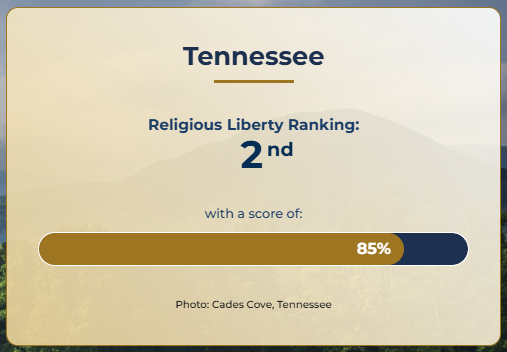
Tennessee's leap from 10th to 2nd came down to a single piece of legislation: the Medical Ethics Defense Act, passed in 2025.
The law protects healthcare providers, institutions, and payers who have conscience objections to certain medical procedures – abortion, sterilization, contraception, and more. Plenty of states already protect medical professionals who object to abortion specifically, but Tennessee's law goes a step further. It shields a much wider group of people and institutions across a broader range of procedures, stating that healthcare providers "must not be required to participate in or pay for a healthcare procedure, treatment, or service that violates the conscience of the healthcare provider."
That law carried Tennessee from the middle of the pack to the top two in the nation on the RLS index. We’re incredibly proud of this distinction, but recognize there is still more work to be done. RLS shared:
Tennessee’s rise is especially notable when compared with other states that might be expected to perform well. Tennessee leads Alabama by roughly 46 percentage points, Texas by about 42 percentage points, and Oklahoma by nearly 35 percentage points. These differences show that a strong religious liberty ranking is not automatic. States improve when policymakers identify gaps in the law and adopt concrete protections for religious exercise and freedom of conscience.
All states have room for improvement, including Tennessee. Despite its second-place standing, the Volunteer State could still add additional protections tracked by RLS, especially in the areas of economic life, religious life, and family and education. By doing so, it may challenge Arkansas for the top spot in future years.
Still, Tennessee’s 2026 ranking should encourage other states to strengthen protections for people of all faiths. The RLS index gives legislators and citizens a clear starting point for identifying gaps in state law and considering proven models from other states.
The same week the RLS report was published, CNBC released a ranking identifying Tennessee as the worst place to live in America based on “quality of life” factors.
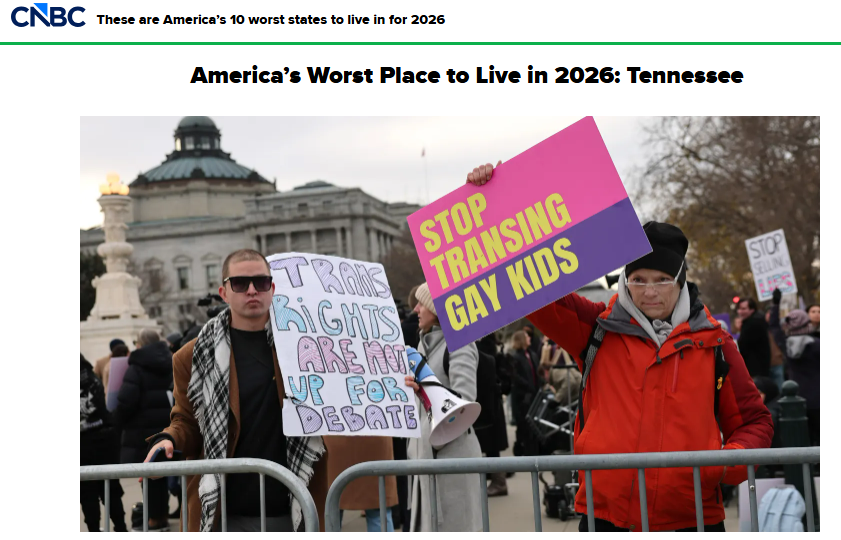
CNBC's report pointed to Tennessee's law requiring individuals to use restrooms matching their biological sex, the state's restriction on localities creating their own antidiscrimination ordinances, and the legislature's resolution declaring June "Nuclear Family Month." According to CNBC, these laws make Tennessee a worse place to live than every other state in the country.
The irony is that CNBC’s “deal-breakers” are exactly what we believe make our state exemplary – and we’re not alone in that belief.
“CNBC just ranked America’s worst place to live in 2026, and the No. 1 spot goes to Tennessee,” a Daily Wire reporter wrote. “But looking at the scorecard, it seems one person’s best life might be another’s worst nightmare. Earning just 64 out of 290 points when it comes to quality of life (it might have gotten an F-minus if it weren’t for that fresh country air), the Volunteer State’s most serious threats to an ideal daily routine are strong families, designated bathrooms, and biology.”
Florida Governor Ron DeSantis even came to Tennessee’s defense, writing on X: “If Tennessee was really the worst state to live in, people wouldn’t be moving there in large numbers, which they are. Typical nonsense.”
CNBC's index didn't rank states based on true "quality of life" metrics – it ranked states based on their willingness to fall in line with the liberal agenda's pillars of "reproductive rights" and radical gender ideology, not to mention the evisceration of parental rights and religious freedom. We're proud to rank last on that list – and 2nd best on the list that actually matters.
FACT remains committed to championing religious liberty and the freedom of conscience for every Tennessean. If this news encourages you, consider supporting our work.
The 2026 Religious Liberty in the States (RLS) index, a project of First Liberty Institute, evaluates all 50 states based on 20 legal safeguards protecting free exercise of religion. This year, the report found that Tennessee protects 85% of those safeguards, making it one of only two states in the country – alongside first-place Arkansas – to earn RLS's "excellent" rating. Last year, Tennessee ranked 10th, and not a single state crossed the 80 percent threshold.
Tennessee's leap from 10th to 2nd came down to a single piece of legislation: the Medical Ethics Defense Act, passed in 2025.
The law protects healthcare providers, institutions, and payers who have conscience objections to certain medical procedures – abortion, sterilization, contraception, and more. Plenty of states already protect medical professionals who object to abortion specifically, but Tennessee's law goes a step further. It shields a much wider group of people and institutions across a broader range of procedures, stating that healthcare providers "must not be required to participate in or pay for a healthcare procedure, treatment, or service that violates the conscience of the healthcare provider."
That law carried Tennessee from the middle of the pack to the top two in the nation on the RLS index. We’re incredibly proud of this distinction, but recognize there is still more work to be done. RLS shared:
Tennessee’s rise is especially notable when compared with other states that might be expected to perform well. Tennessee leads Alabama by roughly 46 percentage points, Texas by about 42 percentage points, and Oklahoma by nearly 35 percentage points. These differences show that a strong religious liberty ranking is not automatic. States improve when policymakers identify gaps in the law and adopt concrete protections for religious exercise and freedom of conscience.
All states have room for improvement, including Tennessee. Despite its second-place standing, the Volunteer State could still add additional protections tracked by RLS, especially in the areas of economic life, religious life, and family and education. By doing so, it may challenge Arkansas for the top spot in future years.
Still, Tennessee’s 2026 ranking should encourage other states to strengthen protections for people of all faiths. The RLS index gives legislators and citizens a clear starting point for identifying gaps in state law and considering proven models from other states.
The same week the RLS report was published, CNBC released a ranking identifying Tennessee as the worst place to live in America based on “quality of life” factors.
CNBC's report pointed to Tennessee's law requiring individuals to use restrooms matching their biological sex, the state's restriction on localities creating their own antidiscrimination ordinances, and the legislature's resolution declaring June "Nuclear Family Month." According to CNBC, these laws make Tennessee a worse place to live than every other state in the country.
The irony is that CNBC’s “deal-breakers” are exactly what we believe make our state exemplary – and we’re not alone in that belief.
“CNBC just ranked America’s worst place to live in 2026, and the No. 1 spot goes to Tennessee,” a Daily Wire reporter wrote. “But looking at the scorecard, it seems one person’s best life might be another’s worst nightmare. Earning just 64 out of 290 points when it comes to quality of life (it might have gotten an F-minus if it weren’t for that fresh country air), the Volunteer State’s most serious threats to an ideal daily routine are strong families, designated bathrooms, and biology.”
Florida Governor Ron DeSantis even came to Tennessee’s defense, writing on X: “If Tennessee was really the worst state to live in, people wouldn’t be moving there in large numbers, which they are. Typical nonsense.”
CNBC's index didn't rank states based on true "quality of life" metrics – it ranked states based on their willingness to fall in line with the liberal agenda's pillars of "reproductive rights" and radical gender ideology, not to mention the evisceration of parental rights and religious freedom. We're proud to rank last on that list – and 2nd best on the list that actually matters.