

Tennessee Ranks 9th on Children’s Rights Scorecard
May 21, 2026 by FACT

This week, Them Before Us, a global children’s rights organization dedicated to putting kids’ needs before adult desires, released the first-ever Children’s Rights Scorecard to shed light on the protection of children across the US. This scorecard is the first tool to clearly measure whether policies put children first or sideline them in favor of adult interests.
The scorecard evaluates laws through a child-centered lens, focusing on children’s rights to stability, identity, and family connection. The scorecard’s website offers an interactive, easy-to-navigate platform where users can explore policy grades, compare issues, and clearly see where laws help or fail children.
As policy debates often fixate on economics and adult desires, this scorecard tool refocuses the conversation on what matters most: Are we putting children first?
Tennessee ranked 9th overall, with our laws on IVF significantly hampering our overall score, bringing our letter grade to a B minus.
“So far, three states—Colorado, Tennessee, and Washington—have declared a ‘right’ to IVF, with three more—Illinois, Ohio, and Minnesota—using language that could be interpreted to include this so-called ‘right,’” the report explained.
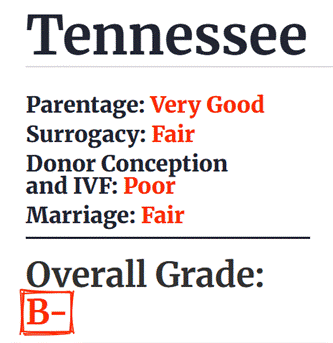
Here’s what researchers based Tennessee’s grade on:
Make no mistake – Tennessee is a pro-family, pro-life, pro-child state. We have made incredible strides in this arena over the past several years, and we have always been a state that values faith, family, and freedom. This scorecard highlights, as we well know, that no state is perfect – including Tennessee. There are several areas where improvement is needed, specifically regarding IVF.
“Children are the most vulnerable members of society, and they deserve policies that protect them,” Katy Faust, Founder and President of Them Before Us, stated. “For decades, we’ve passed laws that prioritize adult desires and called it ‘progress,’ while children bear the heavy cost. When lawmakers can clearly see where policies protect children and where they fail them, it creates real pressure to shift priorities and reshape laws so they truly support and uphold children’s rights.”
FACT remains steadfast in our dedication to championing children’s rights, particularly when it comes to safeguarding natural marriage and the nuclear family unit. Click here to support this vital mission.
The scorecard evaluates laws through a child-centered lens, focusing on children’s rights to stability, identity, and family connection. The scorecard’s website offers an interactive, easy-to-navigate platform where users can explore policy grades, compare issues, and clearly see where laws help or fail children.
As policy debates often fixate on economics and adult desires, this scorecard tool refocuses the conversation on what matters most: Are we putting children first?
Tennessee ranked 9th overall, with our laws on IVF significantly hampering our overall score, bringing our letter grade to a B minus.
“So far, three states—Colorado, Tennessee, and Washington—have declared a ‘right’ to IVF, with three more—Illinois, Ohio, and Minnesota—using language that could be interpreted to include this so-called ‘right,’” the report explained.
? Mother-Father Language: Tennessee parentage law maintains language that refers to mothers and fathers.
???? Surrogacy: Tennessee statute defines surrogacy, but it neither classifies it as legal nor illegal. Pre-birth orders are generally granted if at least one commissioning parent is genetically related to the child.
? Donor Conception and IVF: Tennessee does not have any laws or case law addressing donor anonymity, donation frequency, or payments to donors. Under Tennessee law, parentage is automatically granted to the mother’s husband in cases of donor conception, and the child’s birth certificate will not reflect their true parentage.
? Redefinition of infertility and right to IVF: Tennessee does not redefine infertility to include “social infertility”, but in 2025, the state passed a law declaring IVF to be a “right”, creating potential challenges for future child-protective regulations on the fertility industry
? Natural Marriage: Tennessee has both constitutional and statutory language recognizing natural marriage (marriage between one man and one woman) as the only valid marriage arrangement. Tennessee has not legitimized same sex marriage.
???? Divorce: Tennessee allows no-fault divorce, but still recognizes fault-based grounds. The state does not require a six-month waiting period before filing or finalizing a divorce (the wait time is 60 days without children and 90 days for divorcing couples with minor children). Parental education on the impact of divorce on children is mandatory for all divorcing parents entering into a parenting plan, but the divorce cannot be denied if one party fails to attend the class, and the requirement may be waived by the court “for good cause.”
???? Surrogacy: Tennessee statute defines surrogacy, but it neither classifies it as legal nor illegal. Pre-birth orders are generally granted if at least one commissioning parent is genetically related to the child.
? Donor Conception and IVF: Tennessee does not have any laws or case law addressing donor anonymity, donation frequency, or payments to donors. Under Tennessee law, parentage is automatically granted to the mother’s husband in cases of donor conception, and the child’s birth certificate will not reflect their true parentage.
? Redefinition of infertility and right to IVF: Tennessee does not redefine infertility to include “social infertility”, but in 2025, the state passed a law declaring IVF to be a “right”, creating potential challenges for future child-protective regulations on the fertility industry
? Natural Marriage: Tennessee has both constitutional and statutory language recognizing natural marriage (marriage between one man and one woman) as the only valid marriage arrangement. Tennessee has not legitimized same sex marriage.
???? Divorce: Tennessee allows no-fault divorce, but still recognizes fault-based grounds. The state does not require a six-month waiting period before filing or finalizing a divorce (the wait time is 60 days without children and 90 days for divorcing couples with minor children). Parental education on the impact of divorce on children is mandatory for all divorcing parents entering into a parenting plan, but the divorce cannot be denied if one party fails to attend the class, and the requirement may be waived by the court “for good cause.”
Make no mistake – Tennessee is a pro-family, pro-life, pro-child state. We have made incredible strides in this arena over the past several years, and we have always been a state that values faith, family, and freedom. This scorecard highlights, as we well know, that no state is perfect – including Tennessee. There are several areas where improvement is needed, specifically regarding IVF.
“Children are the most vulnerable members of society, and they deserve policies that protect them,” Katy Faust, Founder and President of Them Before Us, stated. “For decades, we’ve passed laws that prioritize adult desires and called it ‘progress,’ while children bear the heavy cost. When lawmakers can clearly see where policies protect children and where they fail them, it creates real pressure to shift priorities and reshape laws so they truly support and uphold children’s rights.”
FACT remains steadfast in our dedication to championing children’s rights, particularly when it comes to safeguarding natural marriage and the nuclear family unit. Click here to support this vital mission.